
Niacinamide vs alpha arbutin vs tranexamic acid: which dark spot ingredient does what?
By the Ozentya team ·
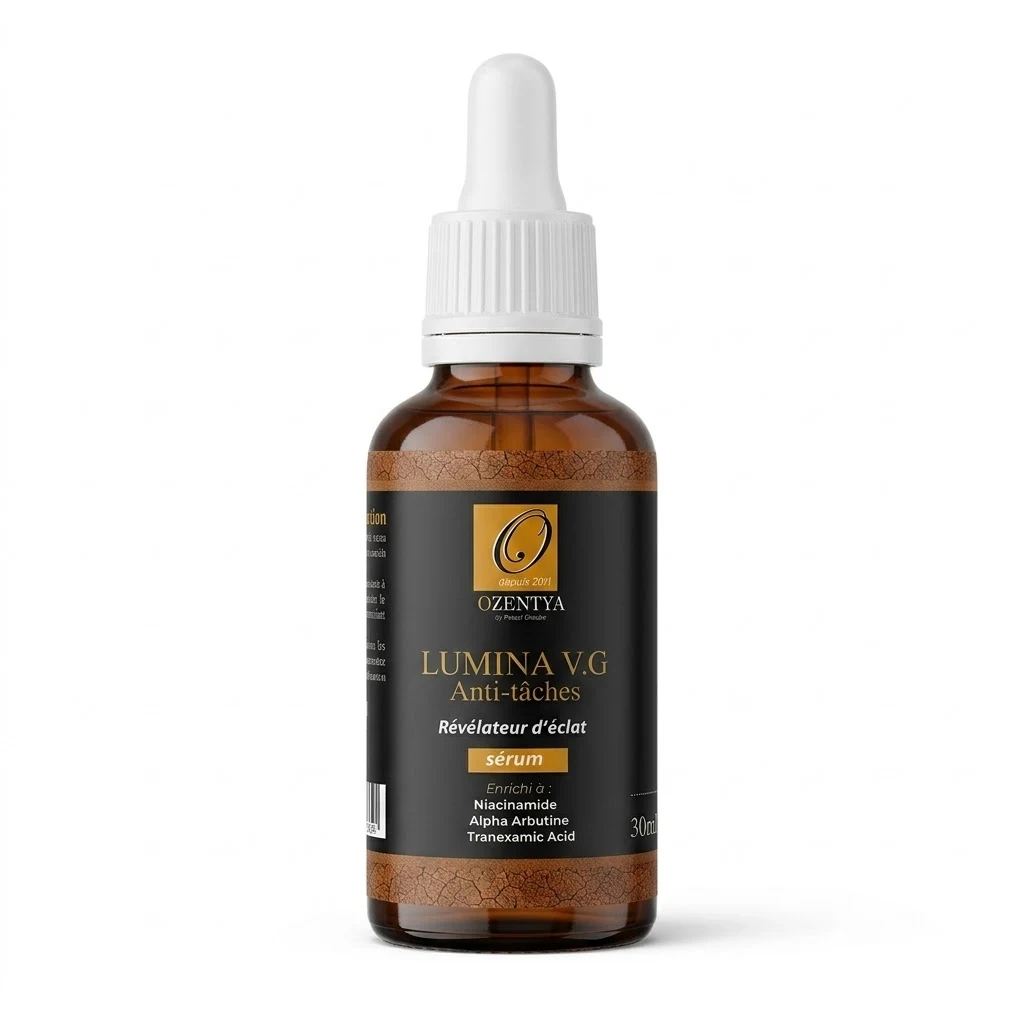
Post-acne marks, sun spots, an uneven-looking complexion: hyperpigmentation is one of the most common skincare concerns, on every skin tone. Three ingredients appear in most serums that target it: niacinamide, alpha arbutin and tranexamic acid. They do not do the same job, which is exactly why they are often combined.
Where do dark spots come from?
Skin colour comes from melanin, a pigment made by cells called melanocytes and passed on to the surface cells. When production runs high in one area (sun exposure, inflammation after a breakout or irritation, hormonal changes), pigment builds up and a spot appears. On deeper and mixed skin tones, post-inflammatory marks are especially common and can stay visible for a long time.
Niacinamide (vitamin B3): the all-round complexion ingredient
Niacinamide is a form of vitamin B3. In skincare it is valued because it:
- helps strengthen the skin barrier and skin comfort;
- helps improve the overall look of the complexion;
- acts on the transfer of pigment to surface cells, which explains its interest for a more even-looking tone (Hakozaki et al., 2002).
It is generally well tolerated and fits easily into morning and evening routines.
Alpha arbutin: targeting pigment production
Alpha arbutin is a molecule related to a compound found naturally in some plants. It is used because it acts on tyrosinase, a key enzyme in melanin production (Boo, 2021). The aim: helping to fade the look of uneven pigmentation and keep it from deepening.
Tranexamic acid: for stubborn marks
Long known in medicine for other uses, tranexamic acid has found its place in skincare targeting the appearance of dark spots and marks. Published research mostly concerns melasma, a type of pigmentation partly linked to hormones and sun (Taraz et al., 2017). In cosmetics it is used in routines aiming at a more even-looking tone.
Why combine them?
Each ingredient works at a different step: alpha arbutin on making pigment, niacinamide on its transfer and on barrier quality, tranexamic acid on some of the signals that keep certain spots going. Putting them together in one serum keeps the routine simple.
That is the idea behind our LUMINA V.G. dark spot serum, which combines the three with white birch, lemon, black mulberry, licorice and elderflower extracts.
How to use a dark spot serum
- Cleanse gently and pat skin dry.
- Apply the serum: 3 to 4 drops on the face, neck and décolleté, avoiding the eye area.
- Moisturise as usual.
- In the morning, protect: a suitable sunscreen is essential. Without it, UV exposure restarts pigment production and undoes the routine.
Patch-test on a small area before first use, and stop if irritation occurs.
What to expect (and what not to)
A dark spot serum is a cosmetic product: it helps reduce the appearance of spots and even out the look of the complexion, but it does not permanently remove every spot and does not replace medical advice. Results vary from person to person and depend on regular use and sun protection. Any spot that changes, grows or bleeds should be checked by a doctor or dermatologist.
Sources
- Hakozaki T. et al. *The effect of niacinamide on reducing cutaneous pigmentation and suppression of melanosome transfer.* British Journal of Dermatology, 2002.
- Boo Y. C. *Arbutin as a Skin Depigmenting Agent with Antimelanogenic and Antioxidant Properties.* Antioxidants, 2021.
- Taraz M. et al. *Tranexamic acid in treatment of melasma: a comprehensive review of clinical studies.* Dermatologic Therapy, 2017.
- American Academy of Dermatology: patient guidance on dark spots, melasma and sun protection.
These studies look at each ingredient on its own, often at specific concentrations and in specific conditions: they are not a study of the LUMINA V.G. serum.
Cosmetic skincare advice: it does not replace the opinion of a doctor or dermatologist. Results vary from person to person, and daily sunscreen is essential when you care for dark spots.
Frequently asked questions
Can I use niacinamide and tranexamic acid together?
Yes, they are commonly combined in the same serum. Simply patch-test on a small area before first use.
Should I apply a dark spot serum in the morning or at night?
Either works, on clean dry skin before moisturiser. In the morning, always finish with sunscreen.
Are these ingredients suitable for dark skin?
They are used on all skin tones and are especially popular for post-acne marks, which are common on deeper and mixed skin tones.
How long before I see a difference?
It varies with the person, how old the spots are, regular use and sun protection. No timeframe can be guaranteed.